Product-data AI readability
across 404 domains.
A specification table a person can read reaches an AI as a string with no context.
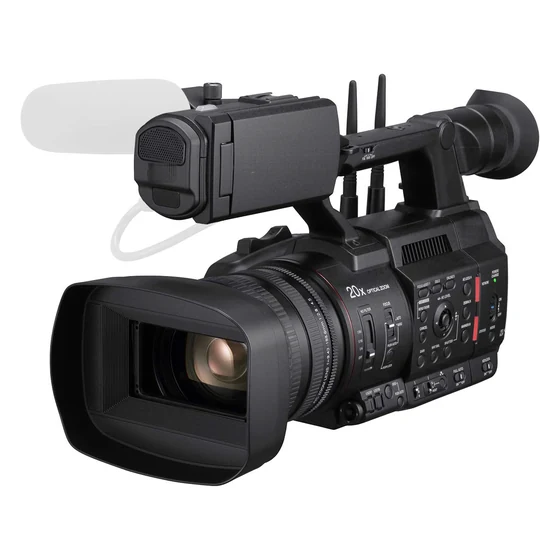
A professional model that records in high-quality 4K and combines ruggedness with mobility. Suitable for a wide range of shooting environments.
| Image sensor | 1-inch CMOS, single |
| Recording format | 4K/59.94p, HD/59.94p *1 |
| Recording media | SDXC ×2 |
| Weight | approx. 2.3 kg (body only) |
| Operating temperature | −5 to 40 °C *2 |
What is on the page is one continuous string. Where the attribute name ends, where the value begins and what the unit is are all undefined.
* Model numbers and values are illustrative.
Values can be read as numbers. An AI can compare them directly against a condition like “4K 60p”. The blue values are the ones that cannot be extracted from the prose on the left.
40% of B2B procurement buyers already use AI search. What an AI answers from is product data: whether the specifications are written in a machine-readable form, and whether there is a compatibility table.
* The 40% is from Deloitte, “Agentic commerce: the future of B2B commerce” (26 June 2026): the share of respondents already using AI agents in procurement.
The specifications are written in catalogue PDFs and in HTML body text. What is undefined is where the attribute name ends, where the value begins, and what the unit is.
We measured whether product data is organised in a form an AI can compare and recommend, across 404 domains, mostly Japanese manufacturers. We found five things.
- 014% have Product structured data. At 1%, the model number is in a state where it is recognised as a SKU or GTIN.
- 02Yet the attributes buyers filter on, such as dimensions, materials and standards, are written in the HTML of 70% of sites, and 81% also publish a catalogue PDF. The information is not missing; it cannot be extracted as parameters.
- 03Search keywords fell by a median of 66.6% over 18 months. They fell at 99% of companies, and at 84% they at least halved.
- 04Over the same period, mentions in AI answers rose by a median of 81.2%. They rose at 96% of companies. The change is industry-wide.
- 05The median product-data AI readability score is 30 out of 100, with a first quartile of 25 and a third quartile of 35. The distribution is narrow: nearly every company sits in the same place.
It is written down.
It just cannot be extracted.
Up to 5 pages per domain were analysed; the figures are the share of domains where at least one page met the condition.
Attributes are written on 70% of sites, yet the model number is an identifier on only 1%. While the model number is mixed into prose, the attributes are not tied to the product.
Search is falling,
mentions in AI answers are rising.
Fell at 99% of companies, and at 84% at least halved. The change is industry-wide.
Rose at 96% of companies, and at 39% more than doubled. In total, mentions per month rose 61%, from 28,019 to 45,003. This reflects movement on the demand side.
The median score is
30 out of 100.
Whether product data is organised in a form an AI can compare and recommend. The scoring is based on the major open standards: schema.org Product, the Agentic Product Protocol, the UCP Catalog and others. For B2B, price and stock are out of scope.
n=299 · 42% of domains score below 30. The distribution is narrow: nearly every company sits in the same place.
How we measured.
What we did not measure.
Scope
404 domains, mostly Japanese manufacturers, collected through 184 audits. The number of domains that could be measured differs by indicator and is stated as n in the text.
Product-data AI readability
Up to 5 pages were fetched per domain and analysed for JSON-LD blocks, Product and ProductGroup nodes, identifiers such as sku, gtin and mpn, and the depth of attributes in the HTML. Pages were fetched by HTTP GET from public URLs and rendered where necessary.
Search keywords
Estimates from a commercial database (Japan, 2025-02 to 2026-07). Two points in time were compared; domains with fewer than 50 keywords at the start were excluded from the population.
Mentions in AI answers
ChatGPT, Perplexity, Google Gemini and SearchGPT, comparing two 6-month periods: the monthly average from September 2025 to February 2026 against the monthly average from March to July 2026. The median ratio is limited to domains with at least 3 mentions in the starting period.
Excluded · Partial months
When an audit runs mid-month, that month counts only a few days. Including it flips the sign of the change in AI-answer mentions. Only complete months were aggregated, and the most recent incomplete month was excluded.
Excluded · File-existence checks
The original check for llms.txt and /.well-known/ucp had a flaw: it followed redirects, so a site that forwards unknown paths to its home page passed by mistake. These checks are excluded from this report's figures.
Assumptions and limits of the analysis
- A sample of up to 5 pages per domain. It does not cover whole sites.
- Search keywords and mentions in AI answers are estimates from a commercial database, not measured access logs.
- Pages whose WAF refused our fetch are not included in the product-data AI readability figures.
- The measurement is a snapshot. A site updated since then differs from what is shown here.
The same method,
applied to your site.
Send us a URL and we show you an instant report on the spot, scoring what can be verified from public information. No access needs to be granted.
Run a free audit of your site