
Build product data from the questions buyers actually ask
Most product schemas are built from the catalog outward. We build them from real buyer questions: voices, the personas found in them, what those buyers are trying to do, and the attribute each question needs. Including the first version that did not work.
Most product data is built from the catalog outward. Someone takes the spec table, turns each row into a field, and the schema is done. It is tidy, and it answers the questions the catalog's authors expected.
Buyers ask other things. They ask how to wire a part, how to adjust it, what replaces the one they already own. If the product data has no field for that, an AI assistant or a search page has nothing to answer with.
So we now build the schema from the other end: from what buyers actually ask. This post explains the words we use, the chain from a buyer's question to a schema field, how we keep the result honest, and the first version that did not work.
Four words we use
A voice is one real thing a buyer wrote. It can be a question on a maker's FAQ, a question on a Q&A site, a question on a distributor's page, or an inquiry the maker shares with us. We collect voices first, before anything else.
A persona is a type of buyer found in those voices. We do not invent it from a job title. We group voices by what the person already knows, what they already own or use, and the words they use. Each persona keeps the list of real voices it came from. There are few of them, usually two to four per product family. If the catalog suggests a persona but no voice backs it, we label it "proposed" and keep it apart.
An intent is what they are trying to do: choose, compare, install or wire, adjust, troubleshoot, replace or find an equivalent, purchase. We measure the mix of intents from real voices. We do not assume it.
A situation is the concrete case inside a persona and an intent: what they hold, what the product connects to, what makes it hard. A situation never restates a printed spec value as a requirement. "The mount stays where it is" is a situation. "Sensing distance of 30 mm" is not; that is the answer, not the case.
From a voice to a schema field
One question is one persona, one intent and one situation together. From there, the chain runs:
voice → persona × intent × situation → question → need → attribute → schema
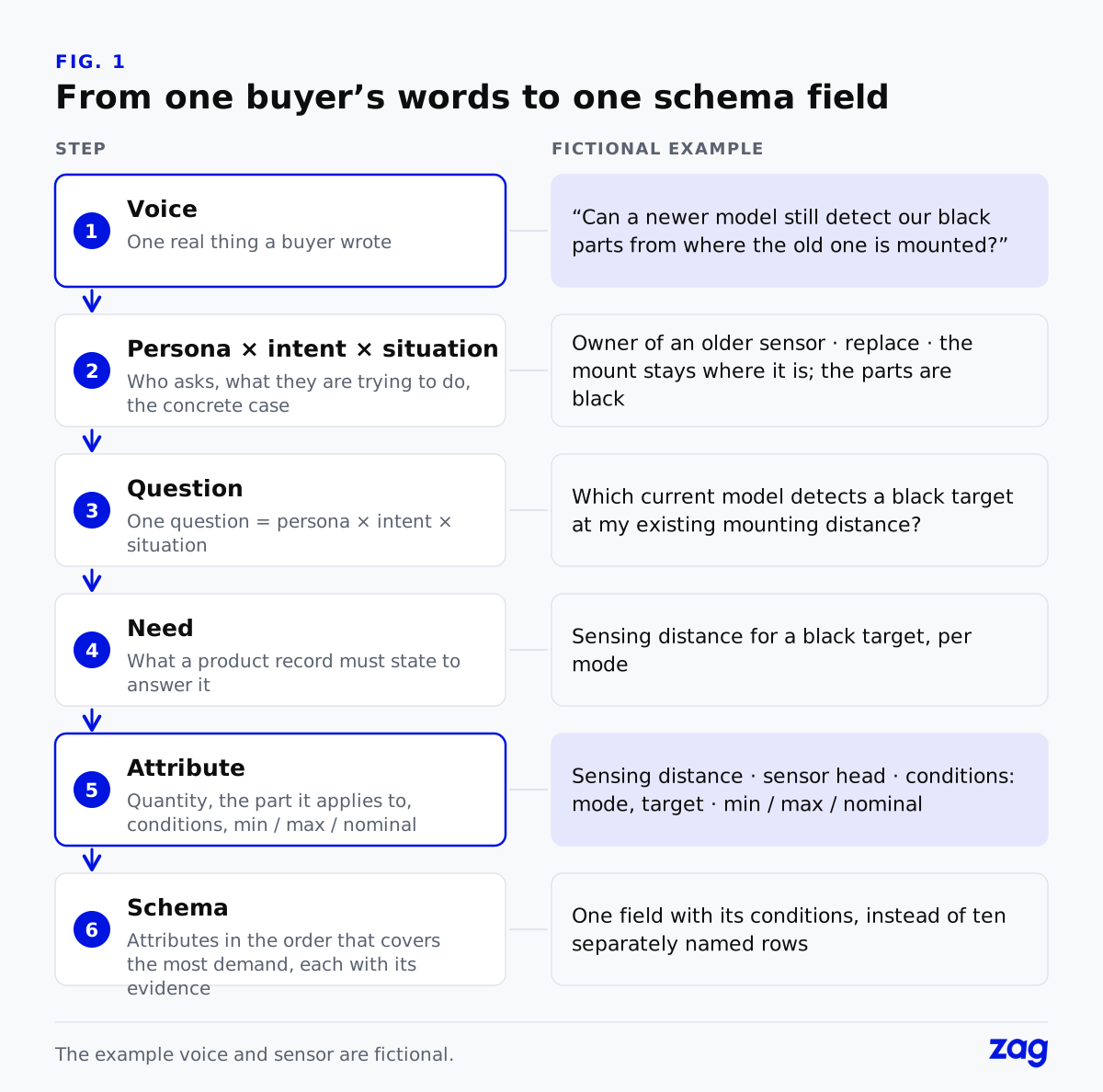
A fictional example. A buyer writes: "Can a newer model still detect our black parts from where the old one is mounted?" That is the owner of an older sensor (persona), who wants to replace it (intent), with the mount staying where it is and black parts on the line (situation). The question becomes: which current model detects a black target at my existing mounting distance?
To answer it, a product record has to state the sensing distance for a dark target, in each mode. That is the need.
Each need is traced to what the record must say, in four parts: the quantity, the part it applies to, the condition, and the minimum, maximum or nominal value. Here that gives one attribute, "sensing distance", with the detection mode and the target as conditions. Not ten separately named rows such as "sensing distance (mode A, white paper)" and "sensing distance (mode B, black rubber)". One field with conditions is easier to fill, easier to compare, and easier for an AI to read.
Attributes are then put in order, starting with the ones that cover the most real demand. Each one shows its evidence: the voices behind it.
There is a useful by-product: the gap list. It is what buyers ask about that the catalog or product database has no field for. In our example, if no record states detection distance for dark targets, that is on the gap list.
Two piles: one to build, one to measure
We split the voices once, at the start, into two piles.
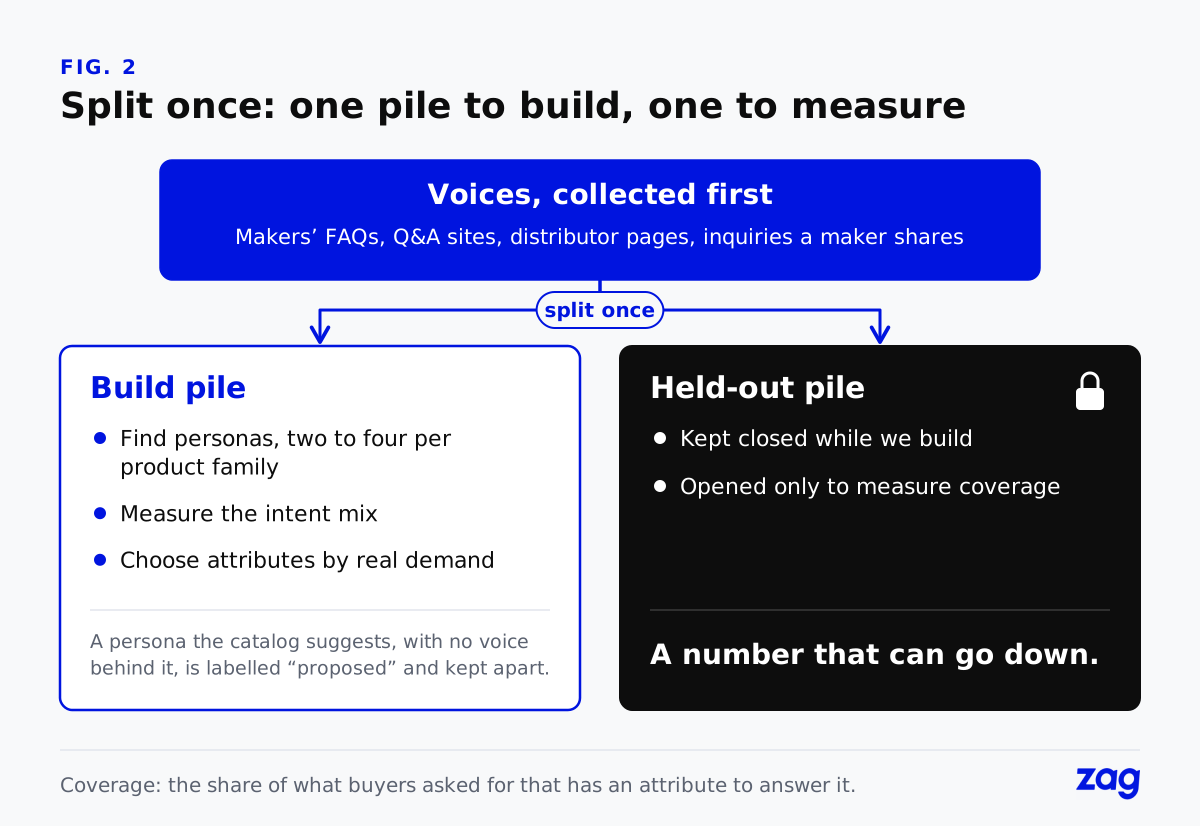
We build from the first pile. We keep the second one closed and only use it to measure: how much of what those buyers asked for has an attribute to answer it. We call that coverage.
Because the held-out voices were never used to build, the score can tell us we are wrong. It is a number that can go down. That matters more than any single result.
What we got wrong first
Our first version wrote personas from the product and the catalog: role, industry, application. It looked reasonable. Then we scored it against real buyer questions, and it did not beat a plain model asked with no personas at all.
The reason was clear once we looked. The simulated buyers mostly asked "which one should I choose?". The real public questions were mostly from people who already owned the product: how to wire it, how to adjust it, what to replace it with. We had built for a buyer who was choosing, while most real buyers had already chosen.
So we changed the order. Personas now come from real voices. The intent mix is measured, not assumed. And the held-out pile keeps us honest.
What about simulation? Personas organise and explain the real questions, and extend them. How much the extension adds is something we measure, not assume.
What a pilot showed
We ran this with an industrial sensor maker on one product family. We measured coverage on 92 real held-out buyer questions.
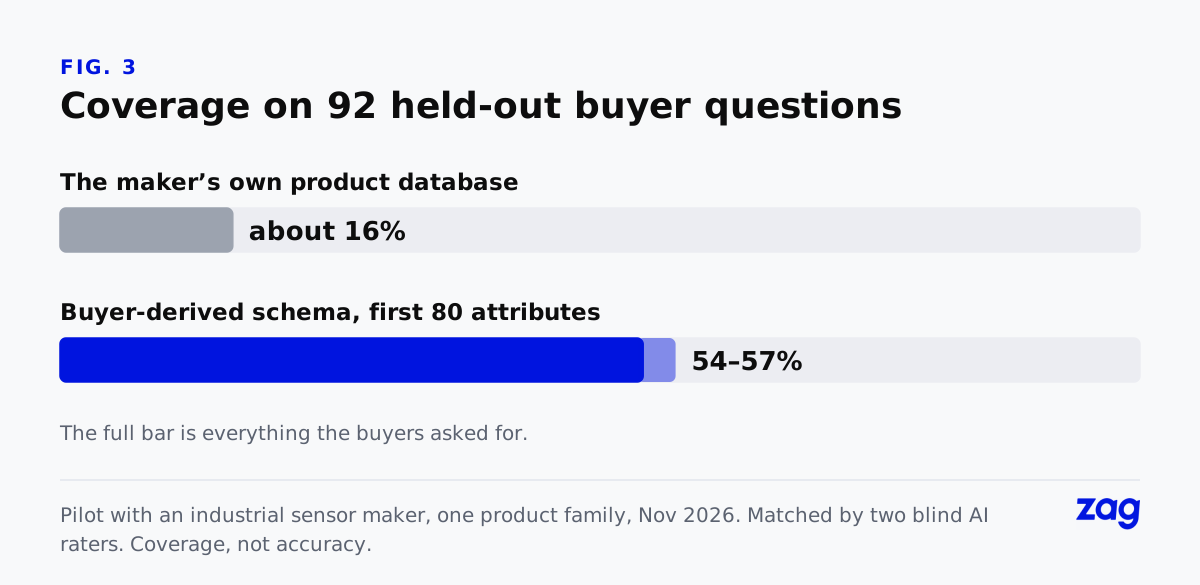
The maker's own product database covered about 16% of what those buyers asked for. The buyer-derived schema covered 54–57% with its first 80 attributes.1
This is coverage, not accuracy. It says whether a field exists to hold the answer, not whether a value in it is right. Filling those fields correctly is separate work.
A service with checkpoints
Nothing in the schema is taken on a model's word. People review each attribute, with its evidence, and either agree with it or question it.
That is why we run this as a service with human checkpoints, not as a self-serve tool.
The common ground
Our work on how brands show up in AI answers also starts from real evidence about people, not from the product. We describe that in A persona is proven by real companies. The two are different jobs with different methods; what they share is where they start.
Sources
-
ZAG pilot with an industrial sensor maker, one product family, November 2026. n = 92 real held-out buyer questions, matched by two blind AI raters. Coverage is the share of what buyers asked for that had an attribute to answer it. The example voice and sensor in this post are fictional. ↩