
A persona is proven by real companies
How ZAG defines the people who ask AI assistants before they buy: types of company kept apart from the roles inside them, each one backed by real companies making a dated, sourced move right now.
A persona is not a demographic. It is a kind of buyer who asks an AI a question before buying, proven by real companies making a real move right now.
This post explains what that means in practice, why we changed our own definition, and what it tells a brand about where to put its effort.
Questions, not prompts
To see how a brand shows up in AI answers, you need a list of questions to ask. Many tools start from "prompts": phrases someone wrote at a desk. We start from the other end. We track what real buyers ask, wherever they search.
That raises a prior question: who are those buyers? If you get that wrong, every question after it is wrong too. So the persona comes first.
Two parts, kept apart
A persona has two parts, and we keep them separate.
- Buyers are types of company. For a point-of-sale (POS) system, that could be franchise restaurant chains, café chains, food trucks and event sellers, or contract caterers. Companies can only sit here.
- People are the roles inside those companies: the operations head, IT and DX, store development, accounting, promotion and CRM, the store manager. They carry the questions and the signals. They never carry a company count.
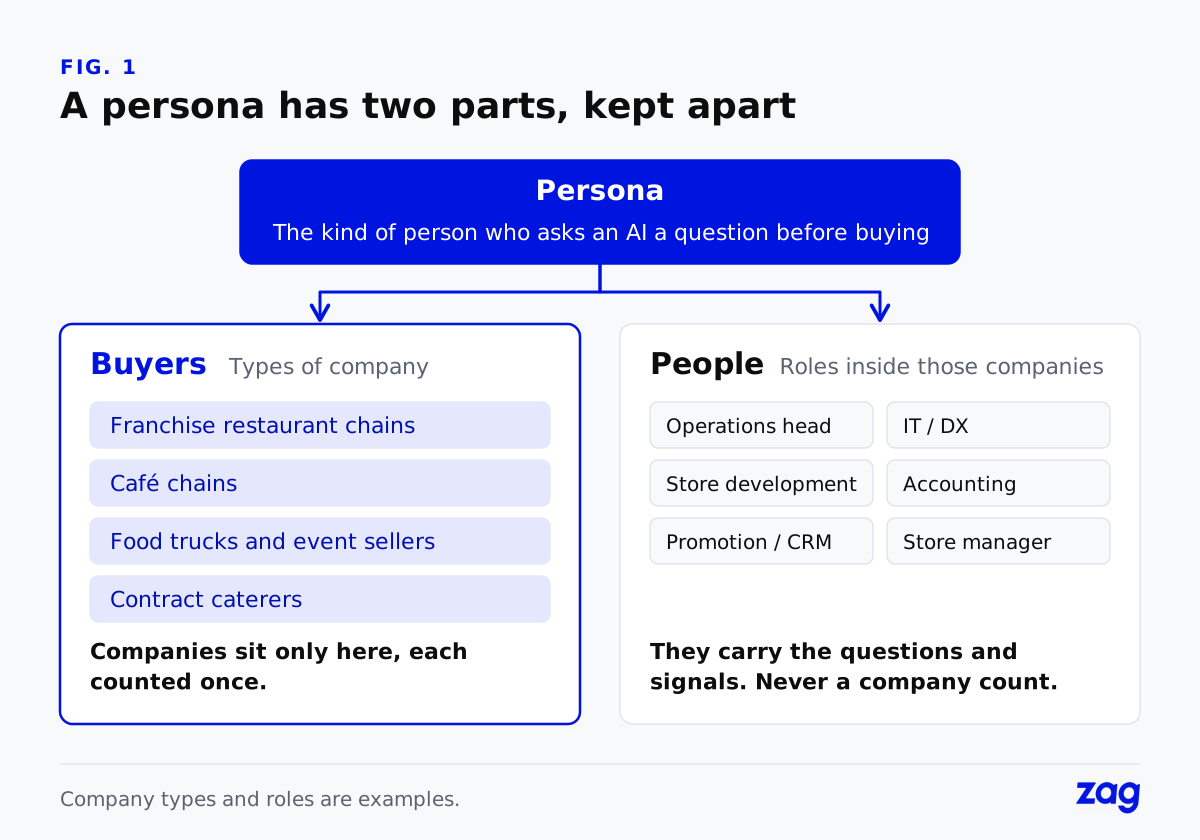
A store manager at a café chain and a store manager at a contract caterer share a title. They do not share a buying situation. Keeping the company type and the role apart lets each question say both who is asking and what kind of business they are asking for.
Why we changed it
Our earlier version was one flat list. Each persona mixed a role and a company type in a single line. Two problems followed.
First, the counts stopped making sense. One role could show zero companies while chains it plainly belongs to appeared under a different role. Second, many personas had the same job title, so the list read as a set of near-duplicates.
Now each persona has a distinct name, and each company is counted once, under its buyer type. The roles sit beside it and carry the questions.
Companies are the proof, not a sales list
Every buyer type is backed by real companies. They are not there as leads. They are there as proof that this kind of buyer exists and has a reason to ask right now.
Each company has to show a recent move that is dated and has a source, for example:
- a new store or a new store format
- a change of system
- a new rule or tax change it has to handle
When a reader from that industry sees the list, the reaction we want is: "these look like me". A surprising, recent company is also a check on us. It shows the persona came from evidence, not from asking a chatbot to invent some buyers.
Two independent readers check each company. If a company has no dated, sourced reason, it is not shown.
A short way to hold the two ideas: the persona is who asks; the signal is why now.
In the product, the companies sit inside a persona as its proof. There is one view per persona, with its companies.
From a company's move to a question
A move by a company changes what its people need to find out. That gives us a chain.
- Signal: a real company makes a dated, sourced move.
- Asks now: the question that move makes the buyer ask an AI.
- Monitor: we track that question in AI answers.
- Win-check: we check whether the brand's website and product data can win it.
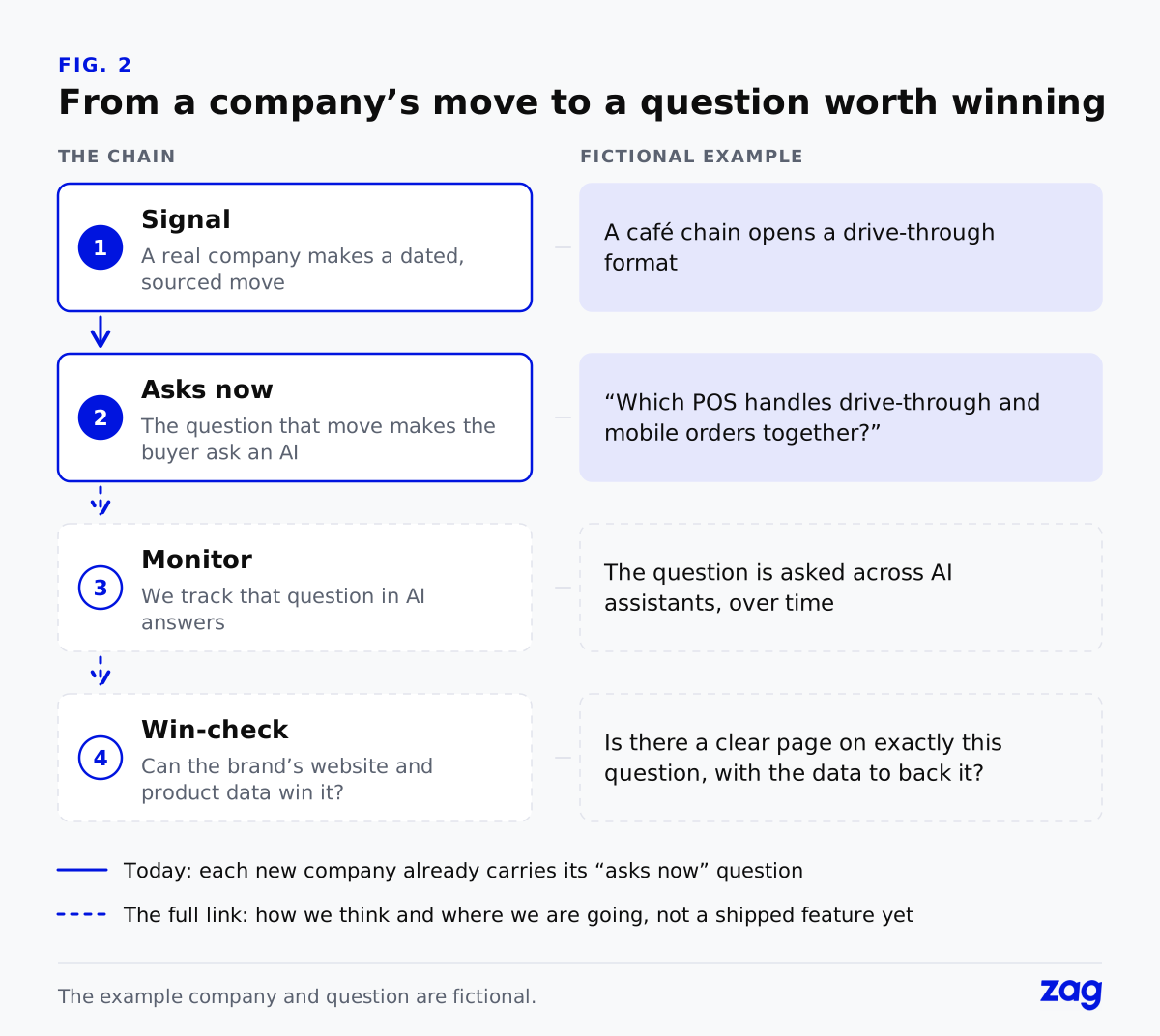
Here is a fictional example. A café chain opens a drive-through format. Its operations head now has a new question: "Which POS handles drive-through and mobile orders together?" That question is worth tracking, because buyers like this one are asking it now.
To be clear about where this stands: today, each new company we add already carries its "asks now" question. The full link, from a company's move to a monitored question to a check of whether the brand can win it, is how we think and where we are going. It is not yet a shipped feature.
Why the unnamed question matters
Why go to this trouble instead of asking AI assistants about the brand directly? Because of what we see when we measure.
In our measurements, across thousands of answers, when a question names a brand, AI assistants talk about that brand almost every time. When the same buyer asks the same need without naming anyone, which is how most questions are asked, the brand shows up in only a small share of answers. The assistants lean on whoever has the clearest pages on that exact question: comparison sites, and rivals' help and how-to pages. Brand strength does not carry over.1
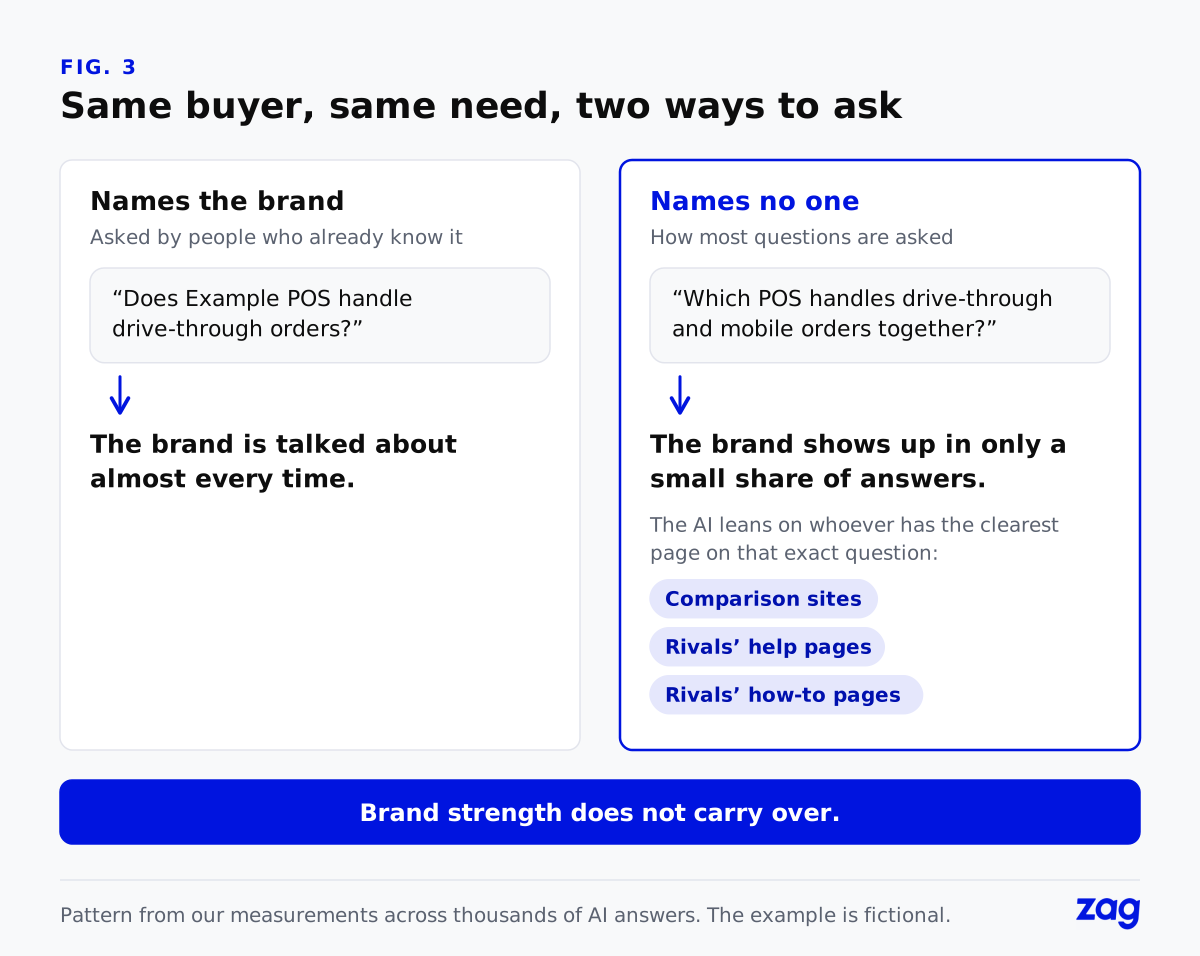
So a brand can look strong when you test it with its own name and still be missing from the questions that decide a purchase. Using the fictional example again: a POS brand that drive-through operators know well may never appear when an operator asks the drive-through question without a name.
What this means for a brand
Most buyers never type your name. The work is being the answer to the questions where nobody asked for you.
That work starts with knowing who those buyers are and what they are asking right now. Real companies with real moves tell you both. From there, the job is concrete: a clear page on the exact question, and product data that states the answer.
Our product-data work starts from the same place: real evidence about people, not the product. It is a different job, with its own method. We describe it in Build product data from the questions buyers actually ask.
Sources
-
ZAG's own measurements of AI assistant answers to buyer questions, with and without a brand name, 2026. Thousands of answers across several AI assistants. The example brand, company and questions in this post are fictional. ↩